
Video in Print
Home » Video in Print
What Is Video-In-Print?
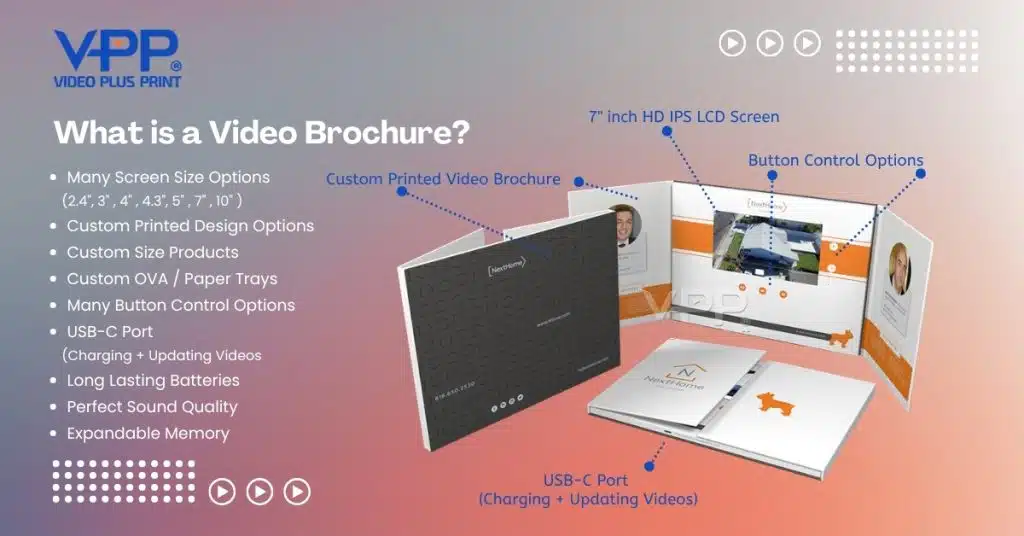
Video-in-Print is a technology that integrates LCD video screens, speakers, rechargeable batteries, and digital memory directly into printed materials and custom packaging.
It allows physical printed products to display video and play sound without requiring an internet connection, smartphone, or external display.
Unlike traditional printing, which relies on static images and text, Video-in-Print adds motion and audio to a physical product.
Businesses use this technology to present information, demonstrate products, explain services, and deliver video content through materials that customers can physically hold and interact with.
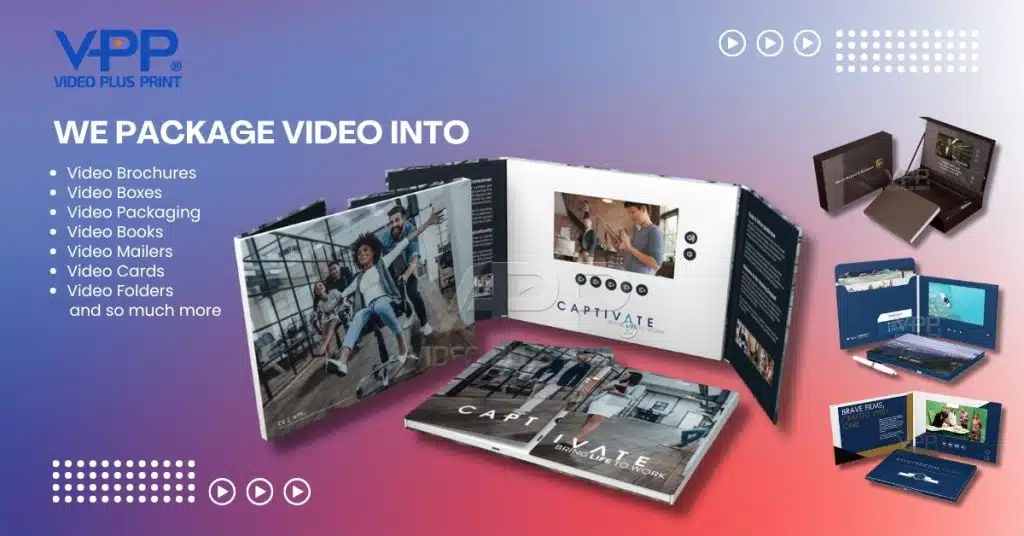
Video-in-Print is the technology behind several types of custom printed products, each designed for different communication, presentation, and packaging requirements.
Types of Video-in-Print Products
Video-in-Print technology can be integrated into different printed formats, from compact cards to larger presentation packaging.
The main product categories include:
Video Brochures: Printed brochures with an integrated LCD screen for presenting video alongside physical graphics and information.
Video Mailers: Video-enabled printed materials designed for direct mail, invitations, and targeted customer communications.
Video Boxes: Custom boxes that incorporate video playback into the packaging or presentation of physical items.
Video Folders: Printed presentation folders that combine document storage with an integrated video display.
Video Books: Bound printed books that incorporate video technology into the reading or presentation experience.
Video Business Cards: Compact printed cards with built-in video capabilities for introductions and professional communications.
Video Packaging: Custom product packaging that integrates LCD video screens and sound into the packaging structure.
Each product uses the same underlying technology but differs in its physical construction, size, layout, and intended application.

Why Is Video-in-Print Different From Traditional Printing?
Traditional printing communicates through photographs, illustrations, graphics, and written information.
Video-in-Print adds another dimension by allowing printed materials to deliver moving images, spoken messages, music, and product demonstrations.
The difference is how people experience the information.
A printed photograph can show what a product looks like.
A video can demonstrate how it works, explain its benefits, and show it in action.
Video-in-Print brings both experiences together without requiring the recipient to visit a website or scan a code.
This makes it a distinct category within interactive print technology, combining the familiar experience of physical printing with the communication capabilities of digital video.
Video-in-Print vs QR Codes and Digital Brochures
QR codes, digital brochures, and Video-in-Print all connect physical or digital materials with video content, but they work differently.
| Feature | Video-in-Print | QR Code Printing | Digital Brochure |
|---|---|---|---|
| Physical printed product | Yes | Yes | Not required |
| Built-in video screen | Yes | No | No |
| Video plays without internet | Yes | Usually no | Depends on file and device |
| Requires a separate device | No | Yes | Yes |
| Built-in audio | Yes | No | Uses external device |
| Rechargeable electronics | Yes | No | Uses external device |
QR codes are a practical and affordable way to direct customers to online content.
Digital brochures are useful when businesses need to distribute information electronically.
Video-in-Print serves a different purpose by placing the video experience directly inside the printed product.
These technologies can also complement one another within a larger marketing campaign.
What Technology Is Used in Video-in-Print?
A Video-in-Print product contains several electronic components that work together inside a custom printed structure.
The main components include:
LCD Display: A compact TFT or IPS screen displays the video content.
Video Playback Circuit: Electronic hardware processes the stored video and controls playback.
Internal Memory: Stores digital video files directly within the product.
Rechargeable Battery: Supplies power without requiring a continuous electrical connection.
Integrated Speaker: Delivers sound alongside the video.
Activation Sensor: Can automatically start playback when a cover or package opens.
Control Buttons: Allow users to pause, adjust volume, or select different videos.
USB-C Connection: Supports charging and content updates, depending on the model.
These components are integrated during manufacturing, creating a finished printed product with its own independent video playback system.
What Can Video-in-Print Actually Do?
Video-in-Print technology supports more than simply playing a single video.
Depending on the electronic configuration, products can include several useful functions.
Automatic Video Playback
A video can begin when the recipient opens the printed product, without requiring a separate play button.
Multiple Video Chapters
Different buttons can be assigned to individual videos, allowing users to select the content they want to watch.
Audio and Volume Control
Built-in speakers deliver narration, music, and other audio content.
Optional controls allow recipients to adjust the sound.
Replaceable Video Content
Stored videos can be updated for new campaigns, revised information, or different audiences.
Video Looping
Some configurations support continuous playback for presentations and display applications.
Custom Screen Integration
LCD screens can be positioned within different printed structures to match the product’s intended use.
The available functions depend on the electronics selected during manufacturing.
How Is Video-in-Print Manufactured?
Manufacturing Video-in-Print requires coordination between commercial printing, electronic assembly, and product finishing.
Unlike standard printing, the finished product must support both physical presentation and electronic operation.
The manufacturing process generally includes five stages.
1. Product Specifications
The screen size, finished dimensions, memory, battery, controls, and construction are established.
2. Artwork Preparation
The customer prepares approved artwork using the supplied production template.
The printed layout accounts for screen openings, control buttons, and other electronic components.
3. Printing and Construction
The printed materials are produced, finished, and prepared for electronic assembly.
4. Electronic Integration
The LCD screen, speaker, circuit board, battery, and other components are installed into the printed structure.
5. Video Loading and Quality Testing
Approved video files are loaded into memory.
The finished product is checked for playback, sound, charging, controls, and overall construction.
Video Plus Print has manufactured custom video-in-print products since 2009, using brand new Grade-A electronic components.
Where Is Video-in-Print Technology Used?
Video-in-Print can support many forms of business communication where physical presentation and video information are both valuable.
Sales and Business Development
Businesses can deliver product explanations, demonstrations, and introductions through a physical presentation.
Corporate Communications
Organizations can communicate executive messages, company updates, and important announcements using video-enabled printed materials.
Training and Education
Video can demonstrate processes, explain procedures, and support instructional material alongside printed information.
Product Demonstrations
Manufacturers can show how a product operates, highlight technical features, or demonstrate its intended application.
Events and Invitations
Printed invitations can contain video messages, event previews, and personalized introductions.
Customer Onboarding
Companies can combine printed reference information with welcome messages and instructions.
Investor and Stakeholder Communications
Organizations can present leadership messages, project overviews, and supporting information in one physical format.
The technology can be adapted to different communication goals without being limited to one industry or product category.

What Should Businesses Consider Before Choosing Video-in-Print?
The best Video-in-Print configuration depends on what the product needs to communicate and how recipients will use it.
Before selecting a product, consider these questions:
Will the recipient watch one video or several?
Does the presentation require detailed visuals or simple messaging?
Will the product be mailed, handed out, displayed, or delivered with another item?
How long will the video content remain relevant?
Will the videos need to be updated later?
Does the product need printed information alongside the video?
How many units are required?
What is the available budget and delivery timeline?
Answering these questions early helps determine the appropriate screen, memory, battery, printed format, and electronic controls.
Video Plus Print offers custom manufacturing with no minimum order quantity, allowing businesses to explore different project sizes and configurations.
The Future of Video-in-Print Technology
Video-in-Print continues to connect two established forms of communication: physical printing and digital video.
As compact display technology and electronic components evolve, manufacturers can explore new printed formats, thinner constructions, improved screen quality, and more flexible playback configurations.
The underlying idea remains straightforward.
Printed materials provide a physical experience, while video communicates information through motion and sound.
Video-in-Print combines these capabilities into a single product.
For businesses exploring interactive print, the technology offers another way to deliver information without depending entirely on websites, mobile devices, or digital advertising.
Video-in-Print Technology FAQs
Q: What is Video-in-Print technology and how does it work?
A: Video-in-Print is a technology that combines printed materials with built-in LCD screens, speakers, rechargeable batteries, and internal video memory. The video plays directly from the product, often starting automatically when the printed cover or packaging opens.
Q: What are the main benefits of Video-in-Print for businesses?
A: Video-in-Print combines the physical experience of printed materials with the storytelling capabilities of video. Businesses use it to demonstrate products, explain services, deliver presentations, and create memorable customer interactions without requiring a separate digital device.
Q: What types of LCD screens are used in Video-in-Print products?
A: Video-in-Print products typically use TFT or IPS LCD screens. IPS displays offer wider viewing angles and improved color consistency, while TFT configurations can provide economical solutions for projects with different requirements.
Q: Can Video-in-Print products be fully customized?
A: Yes. Video Plus Print manufactures custom Video-in-Print products with different screen sizes, printed dimensions, memory capacities, button configurations, materials, and finishes. Customers provide their approved artwork using supplied production templates.
Q: How much does Video-in-Print cost?
A: Video-in-Print pricing depends on the product type, LCD screen size, quantity, construction, electronics, printing, and delivery requirements. Smaller printed products generally cost less than larger presentation packaging with premium materials and electronic configurations.
Q: How long does a Video-in-Print battery last?
A: Battery life varies according to screen size, battery capacity, brightness, volume, and video playback requirements. Many configurations provide approximately one to four hours of continuous playback before requiring a recharge.
Q: Can Video-in-Print products be used for personalized marketing?
A: Yes. Video-in-Print products can contain personalized video messages for individual customers, prospects, employees, or business accounts. Companies can use personalized content for sales outreach, executive communications, invitations, and targeted marketing campaigns.
Q: What video formats are compatible with Video-in-Print products?
A: MP4 using H.264 encoding is commonly recommended for Video-in-Print products. The video should also match the LCD screen’s supported resolution and aspect ratio to help ensure reliable playback and image quality.
Q: How long does it take to manufacture Video-in-Print products?
A: Manufacturing typically takes approximately three to six weeks after artwork approval, depending on product specifications, quantity, customization, and production requirements. Shipping time may vary by destination.
Q: Are Video-in-Print products suitable for international marketing campaigns?
A: Yes. Video Plus Print manufactures Video-in-Print products for customers across the USA, UK, Europe, Canada, Australasia, Middle East, and Asia. International door-to-door shipping is available, with duties and taxes included when specified in the quotation.
Q: Can Video-in-Print replace traditional printed marketing materials?
A: Video-in-Print can replace certain traditional printed presentations when video adds meaningful value. However, it is often most effective as a complementary marketing tool for targeted audiences, premium communications, and campaigns requiring more detailed explanations.
Q: How does Video-in-Print improve product demonstrations?
A: Video-in-Print allows businesses to show products in action directly within printed materials. Customers can watch demonstrations, view product features, and hear explanations without needing to access a website or use a separate device.
Q: What printing finishes are available for Video-in-Print products?
A: Video Plus Print offers a range of custom finishes, including matte, gloss, soft-touch lamination, Spot UV, foil stamping, embossing, and debossing. Available finishes depend on the printed materials and product construction.
Q: Can Video-in-Print products play videos automatically when opened?
A: Yes. Many Video-in-Print products use magnetic sensor technology to activate playback when the cover or packaging opens. This allows the video to begin without the recipient pressing a button.
Q: Are Video-in-Print products reusable for different campaigns?
A: Yes. Many Video-in-Print products can be reused by replacing the stored video through a USB or USB-C connection. This allows businesses to update their message while retaining the original printed product.
Q: Is Video-in-Print suitable for corporate training and employee onboarding?
A: Yes. Video-in-Print can deliver instructional videos, company introductions, safety demonstrations, and onboarding information alongside printed reference materials. Employees can replay the content whenever they need it.
Q: What is the difference between Video-in-Print and traditional digital advertising?
A: Video-in-Print delivers video through a physical printed product, while digital advertising typically appears on websites, mobile devices, or online platforms. Video-in-Print does not require internet access or a separate screen and is often used for direct, targeted communication.
Q: Can Video-in-Print products include custom video control buttons?
A: Yes. Depending on the configuration, products can include play/pause, volume up/down, fast forward, rewind, and individual video selection buttons. The button labels and printed artwork can be customized to match the project.
Q: Is there a minimum order quantity for custom Video-in-Print products?
A: No. Video Plus Print offers custom Video-in-Print manufacturing with no minimum order quantity. Businesses can request pricing for individual projects, pilot programs, small campaigns, or large-volume production.
Q: Why choose Video Plus Print as a Video-in-Print manufacturer?
A: Video Plus Print has manufactured custom Video-in-Print products since 2009. As a direct manufacturer, the company offers factory-direct pricing, brand new Grade-A electronics, custom product configurations, video preloading, quality control, and worldwide shipping.
Video Brochure Product Video
Get a Quick Free Quote Now!