TL;DR
Custom Video Box pricing can typically range from approximately $35 to $90 per unit, including delivery for many standard projects, depending on quantity, box dimensions, LCD screen size, internal construction, memory, printing, finishes, product inserts, and shipping destination.
The size and thickness of the actual box can have just as much impact on the final price as the video screen. A compact 4.3″ Video Box designed for a sales presentation is very different from a large luxury box containing a 7″ screen, custom foam insert, product samples, premium finishes, and additional packaging.
Direct Answer
So, how much does a custom Video Box cost in 2026?
For many Video Plus Print projects, a practical planning range is approximately $35 to $90 per Video Box, including delivery, depending on the final specifications and quantity.
But there is an important reason the range is so wide.
A Video Box is not simply an LCD screen placed inside cardboard.
It is custom packaging built around an experience.
The size of the box, screen, product cavity, insert material, memory, buttons, print finishing, battery, packaging, and shipping volume can all change the final cost.
A smaller Video Box designed to hold a brochure or presentation may land near the lower end of the range.
A large premium presentation box containing a product, custom insert, 7″ or 10″ LCD screen, foil, soft-touch lamination, and specialized packaging will naturally cost more.
Video Plus Print also has no minimum order quantity, allowing businesses to produce a prototype, a small VIP project, or a large-volume campaign.

A Video Box Is Really Two Products in One
Most packaging has one job.
Protect what is inside.
A Video Box has another job.
Tell the story.
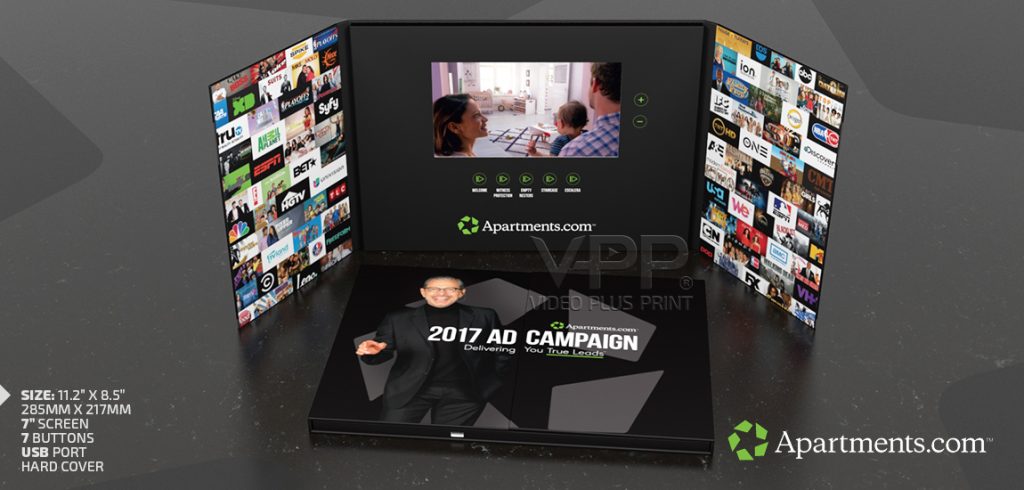
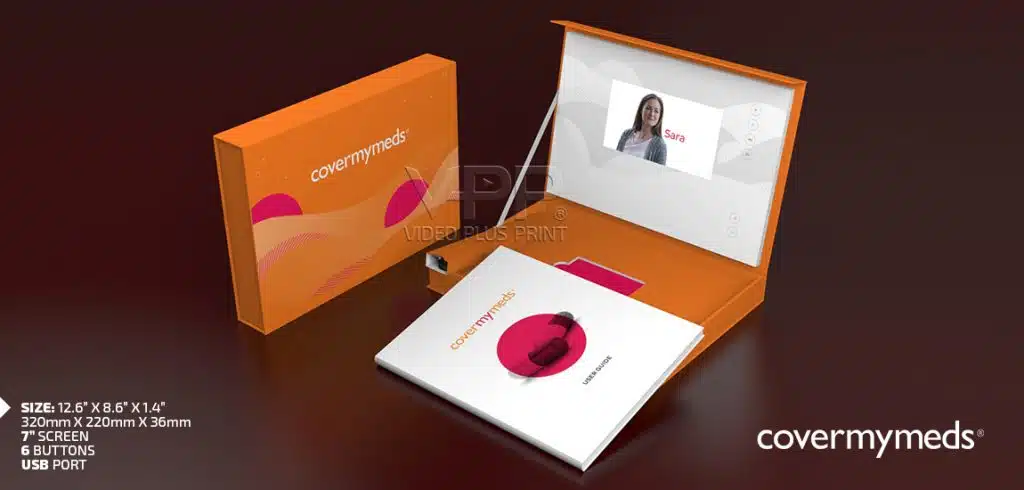
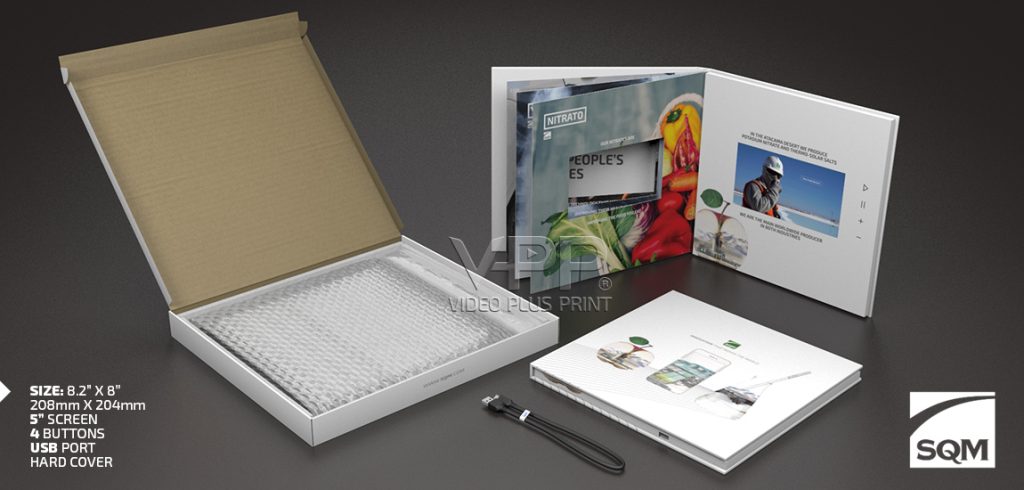
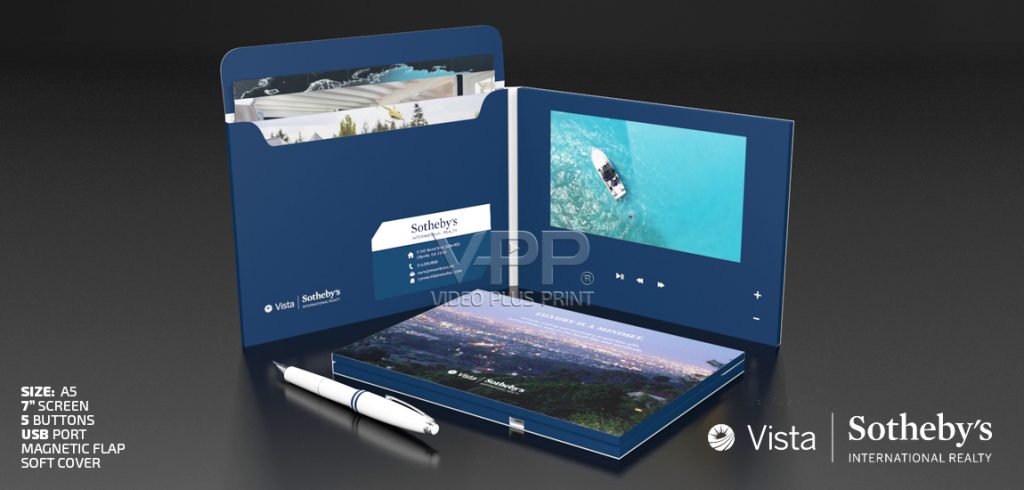
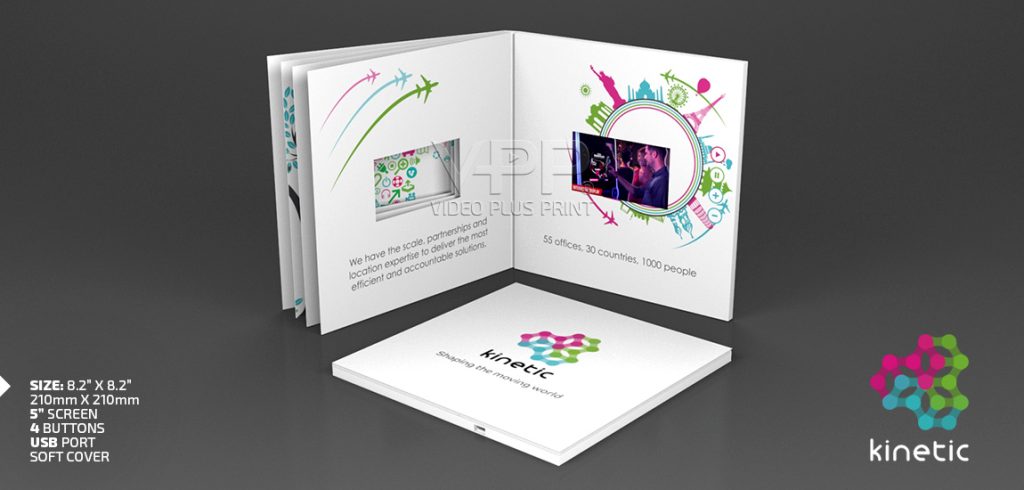
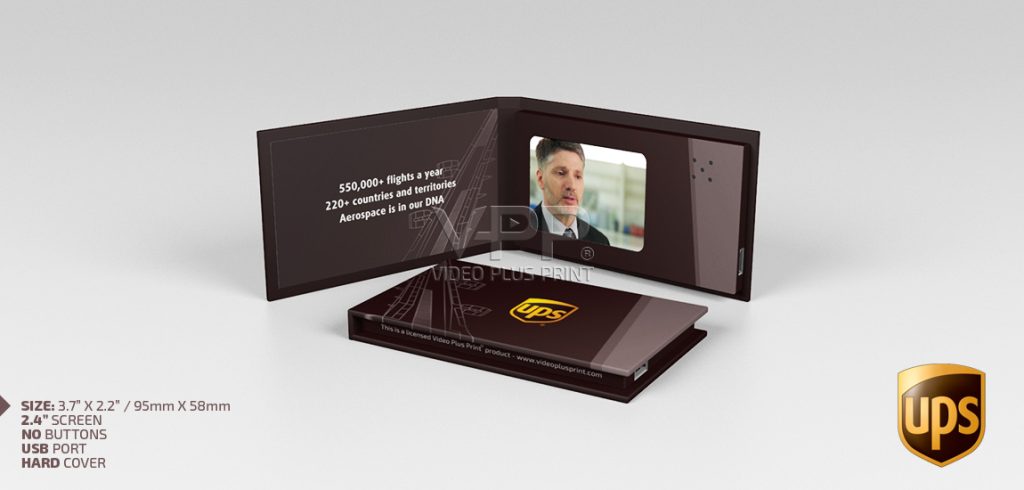
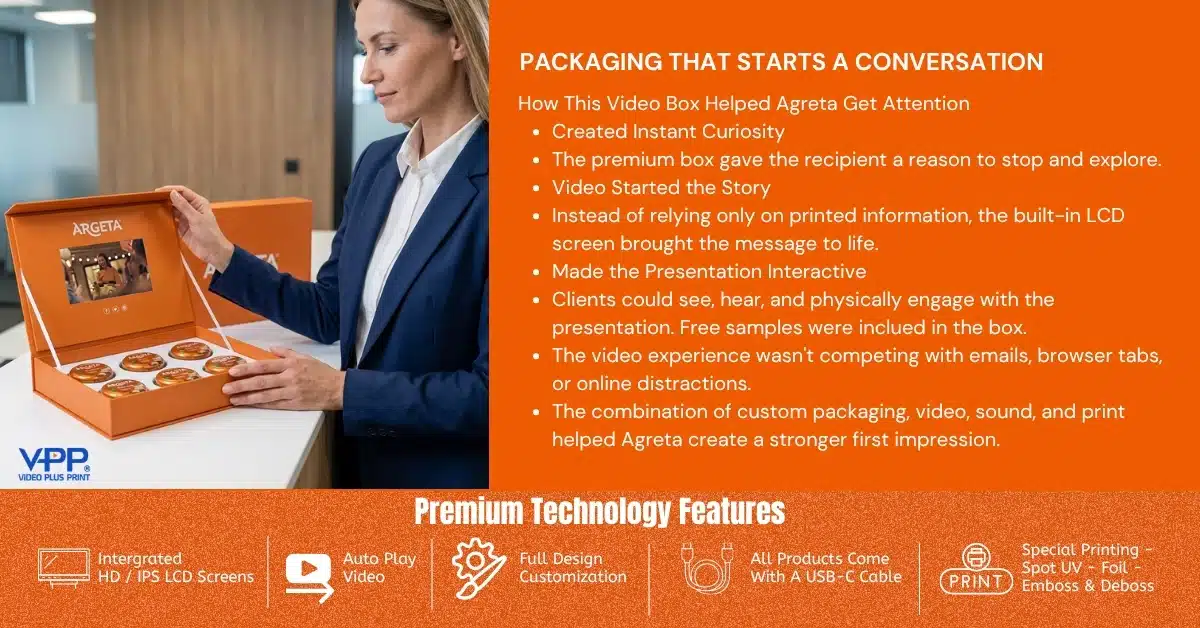
When the recipient opens the lid, an LCD screen can begin playing a video directly inside the packaging.
That means one piece can combine:
- Custom printed packaging
- LCD video screen
- Built-in speaker
- Rechargeable battery
- Internal video memory
- Product compartment
- Custom insert
- Video controls
- Branding
- Product information
Instead of receiving a product and then searching online to understand it, the recipient can watch the story while the product is sitting directly in front of them.
That is why Video Boxes are used differently from ordinary packaging.
What Are Companies Actually Paying For?
When someone asks for Video Box pricing, it is tempting to focus only on the screen.
But the LCD is just one part of the product.
You are also paying for the physical structure surrounding it.
That can include:
- Hardcover construction
- Printed wrap
- Magnetic closures
- Custom product cavities
- Foam inserts
- Paperboard inserts
- Protective packaging
- Electronics
- Assembly
- Video programming
- Printing
- Quality control
- Shipping
Every one of these choices affects the finished product.
And every one can affect the price.
What Screen Sizes Can Be Built Into a Video Box?
Video Plus Print currently offers the following LCD screen sizes:
- 2.4″
- 2.8″
- 3″
- 4″
- 4.3″
- 5″
- 7″
- 10″
For most Video Box projects, the decision comes down to balancing visual impact with the overall dimensions of the package.
Smaller Screens Keep the Packaging Compact
A 2.4″, 2.8″, 3″, or 4″ LCD can work well when the package itself needs to remain relatively small.
These sizes can make sense for:
- Invitations
- Small gifts
- Compact promotional items
- Product samples
- Executive communications
The screen is still unexpected, but it does not dominate the entire package.
4.3" and 5" Screens Work for Many Corporate Projects
These sizes can provide plenty of viewing area without forcing the box to become excessively large.
They work well for:
- Product introductions
- B2B campaigns
- Technology
- Healthcare
- Financial services
- Corporate gifting
- Sales presentations
A 4.3″ or 5″ screen can often provide a strong balance between presentation and overall project cost.
When the Screen Is Part of the Wow Factor
A 7″ display makes video much more prominent.
This can work particularly well for:
- Luxury products
- Influencer kits
- Automotive campaigns
- Premium corporate gifts
- Product launches
- VIP presentations
- High-value customer campaigns
At this size, video becomes one of the first things the recipient notices when the box opens.
What About a 10" Screen?
A 10″ LCD creates a very different type of presentation.
The packaging needs to be larger to support it, but the visual impact can be substantial.
This format can make sense for large premium products, executive presentations, high-end product launches, and campaigns where the video needs to be a major part of the experience.
The important thing is not to automatically select the largest screen.
Build the box around the story you want to tell.
Why Box Dimensions Matter More Than Many Buyers Expect
This is one of the biggest pricing factors.
Imagine two Video Boxes.
Both contain a 7″ screen.
The first is approximately the size of a book.
The second needs enough interior space for a large product.
Their electronics may be similar.
Their final costs may not be.
Why?
Because shipping is affected by more than weight.
Large cartons take up more physical space.
When hundreds of boxes are packed together for transportation, the total shipment volume can become substantial.
That means the length, width, and especially thickness of a Video Box can have a major effect on delivered pricing.
Sometimes reducing the thickness of a package by a relatively small amount can improve shipping efficiency across hundreds or thousands of units.
That is why Video Box engineering should begin with both the product and the delivery requirements in mind.
The Product Inside Changes the Entire Design
One of the first questions we ask about a Video Box is simple:
What are you putting inside it?
That answer determines a lot.
Maybe it is:
- A bottle
- A cosmetic product
- Electronics
- A book
- A sales kit
- A financial presentation
- Promotional merchandise
- A sample
- A piece of jewelry
- A prototype
- A gift
- Several different products
The box should be designed around the contents.
If the product moves around when the recipient opens the package, the presentation immediately feels less premium.
A proper insert keeps everything exactly where it belongs.
What Kind of Insert Should You Use?
There is no universal answer.
Different projects need different internal structures.
Options can include:
Foam Inserts
Useful when the product needs protection or a precisely cut cavity.
Paperboard Inserts
A good choice when the product is lighter and the presentation needs to remain efficient.
Custom Trays
Useful for holding multiple objects or products in specific positions.
Open Compartments
Sometimes a simple cavity is all that is required.
The correct insert should protect the product while also making it easy to remove.
It should look intentional.
Not improvised.
Does a Custom Insert Increase Video Box Pricing?
Yes.
The amount depends on the material and complexity.
A simple paperboard tray generally requires less manufacturing than a highly customized foam insert with several precisely cut cavities.
The shape of the item matters too.
A rectangular product is usually easier to accommodate than an unusual object with multiple components.
For pricing, Video Plus Print will normally need the exact dimensions of anything going inside the box.
Ideally:
- Length
- Width
- Height
- Weight
If several items are included, provide measurements for each one
Here's Where Premium Finishes Change the Experience
A premium Video Box is touched before the video ever starts.
That makes the exterior important.
Video Plus Print can manufacture packaging with finishing options such as:
- Matte lamination
- Gloss lamination
- Soft-touch lamination
- Anti-scratch finishing
- Spot UV
- Foil
- Embossing
- Debossing
These finishes do more than decorate the box.
They change how it feels.
A luxury brand may want soft touch with foil.
A technology company might use a clean matte finish with selective Spot UV.
A corporate presentation may only need strong printing and a refined matte surface.
More finishing is not always better.
The finish should match the brand.
Does Foil or Spot UV Add Much to the Price?
It adds cost, but usually it should be considered in the context of the entire presentation.
If you are producing a premium package for an important customer, a carefully used foil logo may provide considerably more perceived value than its manufacturing cost.
The same applies to Spot UV.
The mistake is covering everything with special effects.
Use finishing to draw attention to selected details.
A logo.
A product name.
A pattern.
A headline.
The best premium packaging often feels restrained rather than overloaded.
How Much Memory Does a Video Box Need?
That depends entirely on the video.
Video Plus Print can configure different memory capacities based on:
- Number of videos
- Video duration
- Resolution
- Compression
If the box contains a two-minute welcome video, the memory requirement may be relatively small.
If it contains several product demonstrations, customer testimonials, training videos, and additional chapters, more memory may be required.
There is little reason to pay for unnecessary storage.
Build the memory specification around the actual content.
One Video or a Full Video Menu?
A Video Box can be extremely simple.
Open it.
One video plays.
For many campaigns, that is all you need.
Other projects need several pieces of content.
For example:
Welcome
Meet the Product
How It Works
Customer Story
Next Steps
Dedicated printed buttons can allow the recipient to select different videos.
Standard controls can also include:
- Play / Pause
- Volume Up
- Volume Down
- Previous
- Next
Adding additional video functions can influence the electronics and programming, but it can also turn the box into a much more useful presentation.
That First Second After the Lid Opens Matters
One of the most effective configurations uses automatic playback.
The recipient opens the Video Box.
The screen activates.
The video starts.
There is no instruction manual.
There is no QR code to scan first.
There is no website.
The experience happens immediately.
This is particularly useful for product launches and gifting campaigns because the video becomes part of the unboxing moment.
Can You Change the Video Later?
Yes.
All Video Plus Print products can have their stored video content updated.
Video Plus Print supplies a USB-C to USB cable, which can be used to connect the Video Box to a compatible computer.
The existing video files can then be replaced with new content.
That gives businesses more flexibility after the original campaign is complete.
A Video Box might initially be used for a product launch.
Later, the video can be replaced with:
- Updated product information
- A new sales presentation
- Training content
- A new customer welcome
- Another campaign message
The physical packaging may stay the same while the message evolves
Is Video Loading an Extra Charge?
No, we load the videos for free for you. Video Plus Print can preload the customer’s approved video content before the finished products are shipped.
That means the products can arrive ready for the campaign rather than requiring someone at the customer’s office to manually load every unit.
This is especially useful for projects involving hundreds or thousands of Video Boxes.
Why Packaging Weight Isn't the Only Shipping Issue
This deserves extra attention because it can significantly influence a quote.
Businesses often assume shipping is based primarily on weight.
For Video Boxes, shipment volume can be equally important.
A lightweight but oversized box may require considerably more carton space than a heavier compact package.
Multiply that by 500 boxes and you may be shipping a large physical volume.
This is why reducing unnecessary empty space can be one of the smartest ways to control overall Video Box costs.
A good design should feel substantial without becoming unnecessarily large.
Should the Product Be Shipped Inside the Video Box?
Sometimes yes.
Sometimes no.
A campaign could be produced in several ways.
Video Plus Print can manufacture the finished Video Boxes and deliver them to the customer, who then inserts the final products locally.
Or the project may involve coordinating the product and packaging together depending on the production plan.
The correct approach depends on:
- Product source
- Quantity
- Delivery destination
- Product weight
- Packaging requirements
- Campaign schedule
Planning this early helps avoid unnecessary handling and shipping costs.
How Does Quantity Change the Cost Per Box?
Quantity matters.
Custom manufacturing becomes more efficient as production increases.
A larger run can spread setup costs across more units.
That generally means a lower price per box.
But larger is not automatically better.
If you only have 25 valuable recipients, ordering 500 boxes because the unit price is lower does not make sense.
The campaign size should match the audience.
Video Plus Print has no minimum order quantity, so businesses can build around the actual project rather than an arbitrary ordering requirement.
Can You Really Order Just One?
Yes.
A single prototype can make sense before approving a major production run.
It gives the marketing team an opportunity to review:
- Box dimensions
- Screen placement
- Product fit
- Insert fit
- Printing
- Video
- Button layout
- Overall experience
A prototype costs more per unit than volume production, but it can be extremely valuable when developing a high-end project.
Seeing the physical product is different from reviewing a digital rendering.
Video Boxes for Product Launches
This is one of the most natural uses for the format.
Imagine launching a new product.
The recipient opens the box.
Before they even remove the product, the founder or product manager appears on screen.
They explain:
Why it was created.
What makes it different.
How to use it.
What problem it solves.
The recipient then sees the actual product directly below the video.
Packaging has just become part of the launch story.
Why Luxury Brands Use Video Packaging
Luxury marketing is often about presentation as much as the product itself.
The anticipation matters.
The materials matter.
The opening experience matters.
Video adds another layer.
A luxury Video Box can combine premium printing, tactile finishes, a carefully positioned product, and a video that introduces the story behind the item.
That can work for:
- Fashion
- Beauty
- Jewelry
- Automotive
- Hospitality
- Premium consumer goods
- VIP customer programs
The packaging itself becomes something people may want to keep.
Influencer Kits Need Something Worth Showing
Influencer packages face a unique challenge.
You cannot control whether the recipient shares the package.
But you can make the experience more interesting to share.
A Video Box or a Video Influencer Box can include:
- Personalized welcome video
- Product introduction
- Campaign message
- Custom product insert
- Branded merchandise
- Samples
- Launch information
When the box looks interesting before the product even comes out, it becomes part of the content opportunity.

Video Boxes Can Work in B2B Too
Video Boxes are not limited to luxury consumer campaigns.
Imagine sending one to the executive team of a major potential account.
Inside is:
- A personalized presentation
- Product sample
- Sales information
- Custom proposal
- Relevant promotional item
The video can explain why the company is reaching out.
The physical items reinforce the message.
The sales representative follows up after delivery.
For a high-value B2B account, that can be a much different introduction from another cold email.
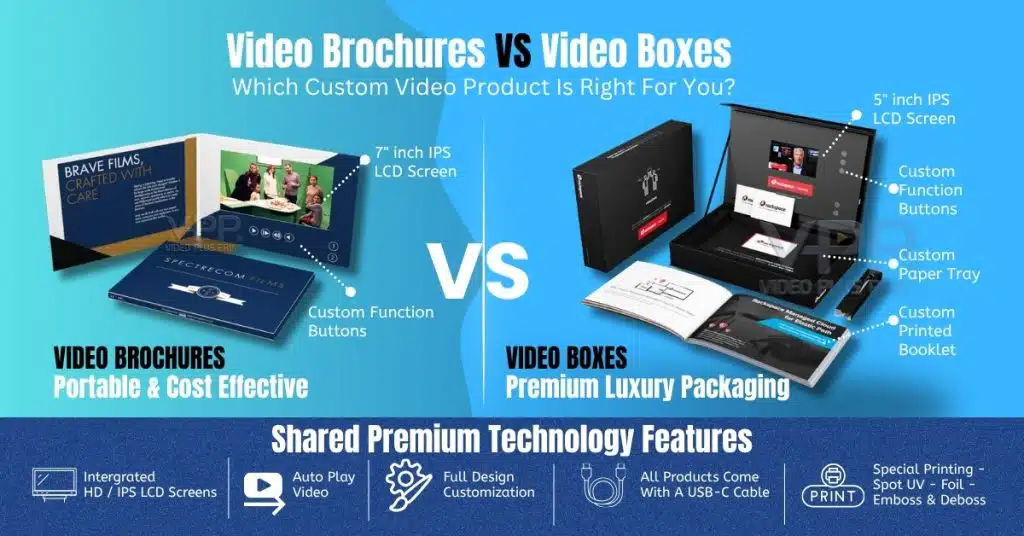
Is a Video Box Better Than a Video Brochure?
It depends on what needs to be included.
Choose a Video Brochure when video and printed information are the primary presentation.
Choose a Video Box when you also need physical space for something.
That might be:
- Product
- Gift
- Samples
- Promotional item
- Documents
- Sales materials
A Video Box provides depth and storage that a traditional Video Brochure does not.
Video Box or Video Mailer?
Again, think about the job.
A Video Mailer is typically thinner and designed around delivering a video message through direct mail.
A Video Box is more dimensional.
It is generally chosen when the opening experience or physical contents are central to the campaign.
If the campaign is primarily about the message, a Video Mailer may be the better choice.
If the campaign is about the message and what is inside, the Video Box becomes more interesting.
How Much Should You Budget for 100 Video Boxes?
There is no single correct figure because configurations vary so widely.
For general planning, many Video Plus Print Video Box projects can fall in the range of approximately:
$35 to $90 per unit including delivery
At 100 units, that could represent a broad project budget of approximately:
$3,500 to $9,000
But that should only be used as an early budgeting range.
A final quotation needs the actual specifications.
One important detail can move the number significantly.
A larger box.
A larger LCD.
A complicated insert.
A premium finish.
A different shipping destination.
This is why Video Box pricing should be based on the physical project rather than a generic online price.
What Information Do You Need for an Accurate Quote?
You do not need to know every technical detail before contacting Video Plus Print.
But the more information available, the more useful the first quote will be.
Provide:
Quantity
How many boxes do you expect to need? We can provide a few qty ranges for you.
Box Dimensions
If you already know them. H x W x L is super important to start the quoting phase of your project.
Product Dimensions
What is going inside?
LCD Screen Size Preference
2.4″, 2.8″, 3″, 4″, 4.3″, 5″, 7″, or 10″.
Number of Videos
One video or several?
Approximate Video Length
This helps determine memory.
Finishing
Matte, soft touch, foil, Spot UV, embossing, or another option.
Delivery Location
Shipping destination affects the delivered price.
Required Date
When does the campaign need to launch?
If you do not know the correct screen or box size yet, Video Plus Print can help determine a practical configuration.
Don't Compare Quotes by the Screen Size Alone
This is one of the most important buying tips.
Two suppliers might both quote:
7″ Video Box
But those two products may not be equal.
Compare:
- Customer Service
- Response Time
- Human to speak with throughout the project
- LCD quality
- Electronics
- Battery
- Memory
- Product dimensions
- Box construction
- Printing
- Insert
- Video programming
- Finishing
- Packaging
- Shipping
- Warranty
A lower price is only a better price when the specifications are actually comparable.
What Does Factory-Direct Pricing Change?
Video Plus Print directly manufactures video-plus-print products.
That means customers are working with the manufacturing source rather than adding another reseller layer between the project and production. We are also in the USA, Canada, Hong Kong. Give our customer service a try, or even ask for references.
Direct manufacturing can provide greater control over:
- Pricing
- Electronics
- Box dimensions
- Screen specifications
- Inserts
- Production
- Finishes
- Quality control
- Customization
For a highly customized product, those details matter.
How Should You Think About Video Box ROI?
A Video Box costs more than standard packaging.
That is obvious.
But premium campaigns should not be judged only on packaging cost.
Ask what the recipient is worth.
If you are sending a box to a prospect worth $50,000 in potential revenue, that is different from sending an inexpensive promotional item to a random mailing list.
Track outcomes such as:
- Meetings
- Qualified leads
- Product trials
- Influencer content
- Sales opportunities
- Customer upgrades
- Repeat purchases
- Revenue
- Donations
- Customer lifetime value
The real question is not:
How cheap can we make the box?
It is:
What result are we trying to create with it?
Video Plus Print Makes More Than Video Boxes
Video Plus Print has manufactured video-in-print products since 2009.
The company produces:
- Video Boxes
- Video Presentation Boxes
- Video Brochures
- Video Mailers
- Video Folders
- Video Packaging
- Video Books
- Video Business Cards
- Video Cards
Projects can be customized around the customer’s screen size, dimensions, printing, memory, controls, finishing, product inserts, and video content.
Video Plus Print also provides video preloading, reusable content, factory-direct manufacturing, global delivery, and a one-year manufacturing warranty.
And there is no minimum order quantity.
The Box Isn't the Campaign
This is worth remembering.
You can manufacture the most impressive Video Box imaginable and still get poor results if it goes to the wrong people.
Start with the audience.
Then build the experience.
Who should receive it?
Why are they receiving it?
What should happen when they open it?
What should they watch?
What should be inside?
What should they do next?
Answer those questions first.
Then build the box.
That is how Video Box pricing becomes part of a marketing strategy instead of simply another packaging expense.
Key Takeaways
- Custom Video Box pricing commonly ranges from approximately $35 to $90 per unit including delivery for many projects, depending on the final specifications.
- Physical box dimensions and thickness can significantly affect shipping costs.
- Video Plus Print offers 2.4″, 2.8″, 3″, 4″, 4.3″, 5″, 7″, and 10″ LCD screens.
- Bigger screens are not automatically better. Choose the screen around the recipient experience.
- Custom foam, paperboard, and product inserts can affect pricing.
- Matte, gloss, soft touch, Spot UV, foil, embossing, and debossing can be used to create different finishes.
- Multiple videos and custom playback controls can be built into a Video Box.
- Automatic playback can begin when the box is opened.
- Video Plus Print products can be updated after delivery using the supplied USB-C to USB cable.
- Video Plus Print can preload approved videos before delivery.
- There is no minimum order quantity.
- Prototypes can be useful before approving large-volume production.
- Businesses should compare complete specifications rather than screen size alone.
- Video Boxes are particularly useful for product launches, B2B outreach, luxury marketing, corporate gifting, influencer kits, and premium presentations.
- The best way to evaluate a Video Box is against the value of the audience and the outcome of the campaign.
Frequently Asked Questions About Video Box Pricing
Q: How much does a Video Box cost?
A: Many Video Plus Print Video Box projects fall between approximately $35 and $90 per unit including delivery, depending on quantity, screen size, box dimensions, memory, printing, finishes, inserts, packaging, and shipping destination.
Q: What is the average price of a custom Video Box?
A: $35-$90 to start, however there is no single average because Video Boxes are custom manufactured. A compact corporate presentation box may cost considerably less than a large luxury Video Box containing a 7″ screen, custom product insert, premium finishing, and oversized packaging.
Q: How much do 100 custom Video Boxes cost?
A: A general planning range for many 100-unit projects can be approximately $3,500 to $9,000 including delivery. Final pricing depends heavily on box dimensions, LCD size, inserts, finishing, and destination.
Q: What affects Video Box pricing the most?
A: Box dimensions, LCD screen size, quantity, product inserts, memory, print finishes, internal construction, packaging, and shipping are major pricing factors. The physical size and thickness of the box can be especially important because of shipping volume.
Q: Does Video Box size affect pricing?
A: Yes. Larger boxes require more material and occupy more shipping space. This can increase both manufacturing and delivery costs, particularly when hundreds or thousands of boxes are being transported.
Q: Why does box thickness affect shipping costs?
A: Shipping is affected by the amount of physical space the finished cartons occupy, not just their weight. A thicker Video Box can substantially increase total shipping volume when multiplied across a large production run.
Q: Does screen size affect Video Box cost?
A: Yes. Larger LCD screens generally cost more and can also require a larger box. Video Plus Print currently offers 2.4″, 2.8″, 3″, 4″, 4.3″, 5″, 7″, and 10″ LCD screens.
Q: What does a custom Video Box price include?
A: Depending on the quotation, pricing can include the custom printed box, LCD screen, speaker, rechargeable battery, internal memory, electronics, programming, video preloading, insert, assembly, quality control, packaging, and delivery. Always review exactly what is included in a supplier’s quote.
Q: How much does a 4.3-inch Video Box cost?
A: The LCD size alone is not enough to provide an exact price. A 4.3″ Video Box may fall toward the lower end of typical Video Box pricing, but box dimensions, quantity, insert design, finishes, memory, and shipping still need to be considered.
Q: How much does a 7-inch Video Box cost?
A: A 7″ Video Box generally costs more than a comparable 4.3″ configuration because of the larger screen and typically larger package. Premium inserts, finishing, and overall box dimensions can further affect the final price.
Q: Are custom product inserts included in Video Box pricing?
A: They can be included as part of a custom quotation. Because insert construction varies significantly, Video Plus Print needs to understand what products are going inside the box and their dimensions before determining the appropriate insert and price.
Q: Can Video Boxes include foam or custom product trays?
A: Yes. Video Boxes can be designed with foam inserts, paperboard structures, custom trays, or other internal configurations depending on the product being packaged.
Q: Is there a minimum order quantity for Video Boxes?
A: No. Video Plus Print has no minimum order quantity. Customers can order a prototype, a small VIP campaign, 100 boxes, or a much larger production run.
Q: Can I order one custom Video Box prototype?
A: Yes. A prototype is a useful way to evaluate dimensions, product fit, screen placement, artwork, video playback, inserts, and the overall opening experience before approving larger production.
Q: Can the video in a Video Box be changed after delivery?
A: Yes. Video Plus Print products can have their stored video files updated after delivery using the supplied USB-C to USB cable and a compatible computer.
Q: Do Video Boxes need Wi-Fi?
A: No. Standard Video Boxes store the video directly in internal memory. The recipient can watch the presentation without Wi-Fi, cellular service, an app, or a separate device.
Q: Can a Video Box play automatically when opened?
A: Yes. Video Boxes can be configured with a magnetic sensor that triggers video playback when the lid is opened, creating an immediate part of the unboxing experience.
Q: Can Video Boxes have multiple videos?
A: Yes. Depending on the configuration, several videos can be stored in the product and assigned to dedicated printed buttons. This allows the recipient to choose between demonstrations, testimonials, company information, product stories, and other content.
Q: Are Video Boxes worth the investment for B2B marketing?
A: They can be particularly useful when companies are targeting high-value accounts. A premium box containing a relevant video, product sample, or sales information can create a much stronger introduction than ordinary outreach when the value of winning the account justifies the investment.
Q: Where can businesses get factory-direct Video Box pricing?
A: Video Plus Print directly manufactures custom Video Boxes, Video Presentation Boxes, Video Packaging, Video Brochures, Video Mailers, and other video-in-print products. Businesses can provide the quantity, box dimensions, product dimensions, desired LCD screen, delivery destination, and other project details to receive a custom factory-direct quotation.